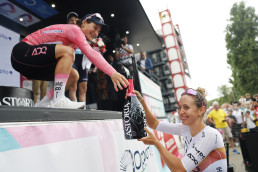
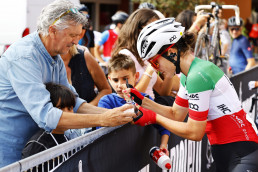
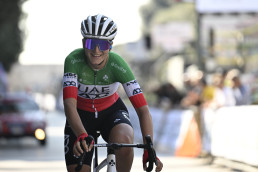
Aux Champs-Élysées
The final snapshot of the 2026 Tour de France carries no nostalgia in the background, but rather the sense that the present is enough in itself – and at times overflowing – in this sport of cycling. The temptation to look back and summon memories is always there when people speak of riders and bicycles, but it would make no sense. Not tonight.
Just this morning on the radio, the signal crackling on a mountain road, someone spoke of the “procession into Paris”, and that too is an expression rooted in what has always happened on the Champs-Élysées, on that final day when celebration framed the closing sprint. Except tonight, on the Champs-Élysées, there is Mathieu van der Poel who, immediately after crossing the finish line, looks for a barrier and leans against it, his lungs shattered by the effort, lactic acid knows where, and a heart as big as anything. Jasper Philipsen looks for him, shakes him, he frees himself from the bicycle and remains on the ground, face to face with the road in Paris, with its cobbles, beneath a barrier.
Mathieu van der Poel has won on the Champs-Élysées, in the final stage of Tadej Pogačar’s fifth Tour de France.
That of Remco Evenepoel, happy and furious; that of Mads Pedersen, relentless; and that of Paul Seixas, all courage and youth. That of Baptiste Veistroffer, who gave it a go again today, and how wonderful that was; that of Adam Yates who, on the Champs-Élysées, was at the front driving the bunch, and only he knows how much he has suffered these past few days; that of Jonas Vingegaard, who was missed before anyone else by his rival, Tadej Pogačar, and who went home looking skywards, pulling a grimace of pain. That of Xabier Azparren who, climbing Montmartre, urged everyone up there to make some noise, knowing they would catch him on camera. That of Juan Ayuso who, one day, suffered, paid the price, lost everything, leaning against a barrier like van der Poel but broken inside, and the next day found the courage to set off again and attack. No easy thing. That of Carapaz and Kuss, that of Torstein Træen. That of Cees Bol, last place, but on the Champs-Élysées. And this is not meant to be a list, or a summary, but rather a cluster of impressions from the present.
On the Champs-Élysées, thanks to Montmartre, there was not a moment’s calm, polka dots and bubbles everywhere. They lit it up once again: Tadej Pogačar, Mathieu van der Poel, Remco Evenepoel and Mads Pedersen. The first time. Only Tadej Pogačar and Mathieu van der Poel the last time. Or rather, the other way round, because on the final passage over Montmartre van der Poel produced one of his trademark accelerations, and even Pogačar had to work hard to get back on. Last year it was Wout van Aert who got in his way; this year it was van der Poel. Last year in the rain, this year in the sun, to borrow the song that shares this piece’s title. We believe he wanted to try to take Paris as well, and he went for it. The chase by the bunch after the two men out front alone would have been worth the price of admission — though there is none, because people climb everywhere to watch and no one says a word, since cycling has its outposts, the most unlikely ones, whether it be rough-edged suburbs, sheer mountains, steep descents, or elegant cities dressed up for the occasion. Mathieu van der Poel and Tadej Pogačar on the finishing straight, the bunch hunting them down from close behind. There is truly everything one could want on the Champs-Élysées.
Both know that danger is imminent: Pogačar sees it, feels it, and yields; van der Poel sees it, feels it, and almost lifts the bicycle off the ground just to squeeze out one more metre. The sprint catches him in the midst of that effort, while his team-mate, Jasper Philipsen, sprints only so that he can point to him with a finger, and the finish-line photograph will capture the detail. One must be open to the unknown in these parts, to what no novelist, however inspired, could ever write. Mathieu van der Poel was. His thousand-string orchestra is that stretch of road after the finish, all those voices, those noises, those sounds, heard from the ground. All that frantic world seen from below. When the sun sets like this, when the Tour de France ends like this, there is the temptation to give in to a hint of regret and look at old photographs. But no, that would not be right. No one will hand us this present ever again. This present is ours.


The long road of Jasper
Jasper Philipsen won in Paris, at the Tour de France, in 2022. A caption like that alone might be enough to make an athlete memorable, because whoever wins at the Tour enters history, and because winning at the Tour, in Paris, on the Champs-Élysées, for anyone – and perhaps above all for a sprinter – is the engagement dreamed of for a lifetime, the evening itself; and lately Paris is reached in the evening, which makes it all the more impossible to miss, awaited in a romantic and melancholy mood. But Jasper Philipsen, born in 1998, a Belgian from Mol, has won no fewer than eleven stages at the Tour de France: the most recent just a few days ago, after he and the team had got everything wrong for days, the first in that very year at Carcassonne. And that is not all: he has six victories at the Vuelta, a Milan–San Remo, a Gent–Wevelgem, a Kuurne–Brussels–Kuurne and the points classification of the Grande Boucle to his name. In Mol, his home town, the rider who had always inspired him, Tom Boonen, had also been born, eighteen years earlier, in 1980. They did not share a career, but Jasper still managed to train a few times with Boonen when he was little more than a boy, and he remembers those rides to this day. Philipsen was not only born in the same town as Boonen but, in cycling terms, resembles him as well. We are talking about sprinting speed, about the skill of moving when the bunch kicks and loses its head in the chaos of a mass finish after stages as flat as a billiard table, but also about mastery on the cobbles, when cycling, in spring, arrives at the Hell of the North. Boonen won Roubaix four times; Philipsen has not yet managed it, but he came close in both 2023 and 2024, finishing second each time behind Mathieu van der Poel, his team-mate and the finest carriage in his train at Alpecin–Deceuninck.
We have all seen the scene more than once and been left admiring it: the power of van der Poel clearing the way for the pure speed of Philipsen who, making use of that slipstream, seems even stronger, more skilful, more gifted, almost impossible to overtake. Jasper has said that at times this partnership also caused him doubts, as though he could not win without van der Poel, as though his presence were necessary for victory and on his own he were worth less. It seems he overcame that fear precisely thanks to the victories in which van der Poel was not there and to those in which he managed to prove equal to such an imposing leader. From his first important successes, he has always spoken of how important it was for him to preserve that light, free approach which allows a rider to face the risks of a complex discipline such as sprinting without being paralysed by fear. He succeeded, at least until the start of this Tour, despite periods that were more or less positive. Then, on the twenty-second of July this year, in Voiron, he found victory again and admitted that he had been close to stopping believing, and yet had been waiting for nothing but that day, had ridden only for that day which never seemed to come, despite all the preparation work. Mathieu van der Poel said something similar. So yes, van der Poel and Philipsen are stronger together, they complement one another athletically in that puzzle which is the sprint and among the cobbles of the Classics; this happens precisely because of the singular qualities of both men, because of the talent of both men. The road Boonen once travelled is the road Philipsen is travelling now, and he is doing so with conviction, now that, as a professional cyclist, Mol is often far away.
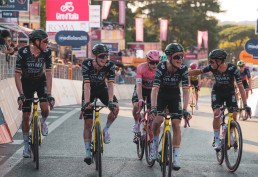
When the Giros come to an end...
The Giri. The Giri that, when they end, feel like adding another year to the count. Because for those who grew up with the Giro, there was the Giro of fifth grade, the Giro of a first love, the Giro of a first heartbreak, the Giro of school-leaving exams, the Giro of that university paper you couldn’t seem to pass, the Giro of that impossible May heat, the Giro of the rain that never stopped, the Giro of the first car, the Giro of that famous new deal that let you send messages all summer long to the people who were far away, while back in the city the humid air hung like a sheet across the sky. And then the Giro of the first job, the Giro of the year work wouldn’t come or had slipped away, the first Giro with your grandparents, the Giro at your parents’ house, the Giro at your own. The Giro of that song, the Giro of that film, of that tune you couldn’t get out of your head. The Giro of when you still used Teletext to check the standings, the Giro of when computers went touchscreen. The first Giro on the road, with someone, and then alone. Because we had grown up, or because we had grown old. The Giri of when we had posters on the bedroom wall, the ones with the books on the bedside table. The Giri of the champions who changed what we dreamed of, the Giri of the domestiques who reminded us what was real. And so here we are, and another Giro has gone by.
The Giri. The Giri that, when they end, it’s Sunday afternoon, sometimes Sunday evening, but it always goes more or less the same way. The leaders’ jerseys parading with their teams, a few glasses of sparkling wine, the words, the chatter, the pats on the back. The crowds around them celebrating, the same and yet different in Milan, in Verona, in Rome. The light feeling more like summer than spring.
The Giri that, when they end, keep you in front of the television watching everything unfold, even though for most of the stage the script is already known by heart – and still you stay. Maybe because, when the Giri end, you understand a little better how much they have to do with you, how much they belong to you, like all things that finish, like all seasons that slip away and are only missed once the air begins to change. And yet they were there just a moment before.
The Giri that, when they end, are the moment when those who couldn’t make it to the race, or who had to leave before it was over, start thinking about the next one. The one they don’t want to miss.
The Giri. The Giri that, when they end, have often already ended the day before – and that final stage is just a parade.
And yet, when the Giri end or have already ended, they still carry inside them a great deal of work done and never quite realised, of bitterness, regret, unresolved thoughts, and lingering doubts. At least for some. Because the celebration is never everyone’s.
There are those who wanted something more, who wanted to do better, to win – at least once, at least a stage. Jonathan Milan is one of them. Even though he says nothing, and smiles. Even though yesterday he went home and breathed. Even though he doesn’t complain, looks ahead, and seems as happy as everyone else. Something was missing for Milan. He found it tonight, in Rome. He won at the last opportunity, and he won the way only Milan can win. He made it clear that tomorrow will be a different kind of Monday – one that matters for this summer, one that matters in general.
There’s always someone missing something when a Giro ends. People say it’s like the last day of school, but when you’re grown up it’s different. When you’re a rider, it’s different again.
The Giri. The Giri that, when they end, there’s the podium.
The Giri that, when they end, you look at Jai Hindley and think about how his Giro ended last year – that crash in Naples, after he’d believed so hard in it. Back on the podium again, third this time. And perhaps it doesn’t matter, or perhaps it does, that no one ever talks about him as much as they should. Because the world, and cycling too, moves forward thanks to riders like Hindley – those who pedal a great deal, appear very little, watch, understand, know, and find that enough. Let others think what they like. Jai Hindley is a rider, a proper rider, and riders can be like that too.
The Giri that, when they end, Felix Gall is second and Jonas Vingegaard is first.
The Giri that, when they end, you can finally hold the person you’ve only kissed through a sticker on the handlebars for too many days, or spoken to on the phone – but the phone is different. The other person is there and isn’t there.
The Giri that, when they end, you have tears in your eyes during the interviews and skin redder than usual. The emotion, and the celebration that comes when the Giri finish and you can stay in Rome a few extra days – bike aside.
The Giri that, when they end, you write the last line of the last piece, close the piece, close the laptop, and sit in silence for a moment. Then you move on to something else. As if nothing had happened.
The faces of the cyclists on Tommaso Dati's day
We don’t know how old the gentleman was who, yesterday morning in Innsbruck, at the start of the first stage of the Tour of the Alps, watched the riders arrive at the team presentation stage and, for at least four or five of them, found physical resemblances to cyclists from the times of our parents and grandparents. He wasn’t speaking to us, but we caught a few names: he mentioned Ottavio Bottecchia, Costante Girardengo, Giovanni Brunero, and Alfredo Binda. He spoke of faces, hair, even similar movements. Perhaps he was right, perhaps not, and to be honest, the latter seems more plausible because, even if we try, we just can’t see those resemblances.
Then, however, we thought of a book we recently read, which argued that as the years go by and many of the people we’ve known are no longer around, the brain strives to find traces of the past in those we meet, and in a way, it overlays the faces of our history onto the faces of others, almost as if it struggles to memorise new ones. So, not only is the cycling our grandparents watch on television often a novel of past stories serving as a backdrop to new stages, but even the appearances of today’s cyclists echo faces from the past in their minds.
Out here, we can no longer see him, but if we were to meet that white-haired gentleman again, we’d ask him who comes to mind when he looks at Domenico Pozzovivo, who, indeed, does have something of a rider from another era.
After all, the Lucanian is only forty-three years old, but his return has sparked a peculiar curiosity, and in his interviews, people search for stories that seem to come from another era of cycling, even though Pozzovivo only retired a year ago. He wanted to dedicate himself to his family, complete his studies, and also avoid the increasingly dangerous roads on which every cyclist spends so much, too much, time.
Next to a rain-streaked window yesterday afternoon, he told us that he came back because his legs are still strong, because he has completed his studies, because he wants to test himself in a sport that is increasingly dominated by youth, and because, in the end, in cycling, when you’re over forty, there isn’t much time left, and if you have an idea, you can’t afford to postpone it. Not just in cycling and not just at forty, we might add, but that’s not the point.
Everyone is drawn to Pozzovivo because his body tells the story of cycling, after all the kilometres he’s ridden and the injuries he’s endured. Everyone is drawn to Pozzovivo because, if he resembles anyone, it’s probably those particular cyclists: taller or shorter than what one might expect from an athlete, with a pedal stroke that’s instantly recognisable, with strong passions and books still in hand long after school is a distant memory. The kind of cyclists you notice and feel compelled to ask at least one question. Domenico Pozzovivo is like them. And, even though we don’t have white hair, this we know for certain.
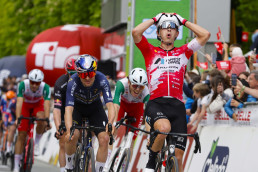
Tommaso Dati, born in 2002, is exactly twenty years younger than Pozzovivo. Over the past few days, his name had been mentioned in connection with this first stage, starting and finishing in Innsbruck, not far from the pastel-coloured houses overlooking an angry Inn River, flowing under a crooked spring moon. However, when Thymen Arensman made his move in the final stretch of the stage, no one was thinking about Dati anymore. Yet, as the peloton reeled in the Dutchman, it was Tommaso Dati who proved to be the fastest.
He hadn’t realised Tom Pidcock was right behind him, only noticing when he turned around. Perhaps that was for the best, as winning is easier without overthinking. The risk, after all, when you’re very young, is to get scared, to be overwhelmed by reverence, and to make mistakes you’d never usually make. Giulio Pellizzari reminded us of this with his expression upon learning that the last Italian to win here was Vincenzo Nibali. As a contender for the overall victory, the weight of such a comparison must have been daunting. Pidcock’s presence carries a similar intimidation. But Dati wasn’t fazed and left him behind.
As we said, Dati is twenty years younger than Pozzovivo, but on the best day of his life – at least in cycling – he said something that the Lucanian could have said himself: “I’m so happy, I’m thrilled. I’ll reflect on this, of course, but when I get home, I’ll just work hard because the road doesn’t end here, and that’s how it should be: I want to reach the World Tour.”
He has the face of youth, and with it, the reserve and gaze of the young. He resembles the cyclist he dreamed of becoming when days like this weren’t even imaginable, and there were only sacrifices and everything that still wasn’t working. It’s the most important resemblance. Nothing more needs to be said.
photo: from TotA
The inspired
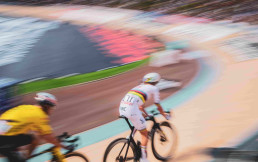
They say that, not long ago in Roubaix, the most inspired cyclist won. We don’t know if that’s true, but today, words fail us, and writing feels like a struggle. Meanwhile, Gianrico Carofiglio’s observation comes to mind: “There are moments when you must speak, and nothing should be taken for granted. Then there are moments when you must remain silent because there’s something intangible and precious in the air, and your words could scatter it in an instant. These are two simple concepts. The hard part is deciding when to apply one rule and when the other.” What each person felt when Wout van Aert crossed the finish line in the Roubaix velodrome cannot be captured in a single piece, because it’s something different for everyone – something tied to their own present and past. And, in the end, what truly matters is what van Aert felt and did. Cyclists, even though we like to believe it and it’s a romantic notion, don’t race to fulfil our lives, resolve our doubts, or symbolise something greater. What you see is exactly what there is. If anything, it’s true that sometimes, because of great athletic feats, we fail to see something that was there. Perhaps that’s what inspiration does.
For van Aert, inspiration might lie in all the misfortune he has endured, here and elsewhere, and in all the nights he went to bed thinking he would give up. He said it himself. Then he woke up the next morning and decided to give it his all once again. That’s how you become inspired. Because inspiration isn’t a sudden flash of light in the darkness. It can be, of course. But more often, it’s simply the sum of all the things that went wrong but didn’t make us walk away. And if inspiration comes from this, it explains the clarity and ruthlessness of Wout van Aert, who, even today, wasn’t spared from misfortune and had to chase back after a puncture. He attacked while Mathieu van der Poel was closing in from behind and delivered the final blow to the Dutchman’s hopes. Being inspired is seeing beyond. It’s looking at the metre of road ahead and already imagining the next two or three metres. They write that in Roubaix, van Aert embraced his destiny. One thing is certain: Wout van Aert knew better than most what had happened to many and what could have happened to him, and he didn’t care because he had already seen too much. He was afraid, yes, because otherwise, you don’t cry like that at the finish line, and because Wout van Aert is a phenomenal man among many phenomenal men. What could happen did happen, and each of the pre-race favourites experienced it.
Tadej Pogačar chased after a puncture more than 120 kilometres from the finish: he rejoined the race after an endless pursuit, and that effort was still in his legs when van Aert overtook him in the sprint amidst the chaos of the velodrome. Mathieu van der Poel tried to make life harder for him, increasing the pace, but when the Slovenian returned to the group during the passage through the Forest of Arenberg, he too was left stranded by a mechanical issue. At one point, he was timed at over two minutes behind. He finished fourth, just fifteen seconds back. Filippo Ganna experienced literally everything – from mechanical problems to a crash. And so it goes, because these strips of cobblestones, uneven and misaligned, are not and will never be ideal for a bicycle. Yet, perhaps precisely for this reason, they keep coming back, and we keep waiting for days like this.
In the end, it came down to two: van Aert and Pogačar. In a way, the worst possible companion for the Belgian, someone who almost never loses. Today, Tadej Pogačar loses, and he loses to a rider for whom even those hoping for the world champion’s victory say: “If someone else had to win, it’s good that it was Wout.” Because a cyclist isn’t there to solve anyone’s life – perhaps not even their own – but it often feels natural to see oneself in a cyclist. And Wout van Aert is a cyclist in whom it’s natural to see oneself because he touches the extraordinary and reacts to the extraordinary as anyone would – not as we’ve been conditioned to think superhumans should.
We don’t think it’s a coincidence that, in the women’s race, it was Marianne Vos who led the charge in Visma I Lease a Bike. Marianne would have dedicated the victory to Henk – her father, who passed away just a few days ago. We’re certain she would have, and we’re also certain that, beyond her undeniable talent, she wanted to take charge of the race herself for this very reason. They also say that Vos was at least as inspired as van Aert, only that inspiration wasn’t enough for her, and Franziska Koch, alone against her and Ferrand-Prévot, outsmarted them both and, after so many strong performances, claimed victory in the Hell of the North.
Yes, inspiration is never enough if everything else isn’t there, but everything else without inspiration feels poorer. Perhaps it’s because the inspired are, after all, those who never walked away from what was going wrong, and everyone – cyclist or not – ultimately wants to hear that again. To see it. To feel it. Something like: “Stay safe for one more night, because it’s too dark outside to decide. Wait for the light to come, wait for a new morning. One more time. And, perhaps, continuing will feel a little less frightening.”
Photo: Poci’s
I won a rock: the Roubaix of Alison Jackson
Even on 8 April 2023, Alison Jackson was no different from usual. On that day too, if someone had asked her, she would have said that, ever since she was a child – and probably even now – she had always wanted to be a country girl. Her father would sometimes take her brother around every corner of their farm in Vermilion, western Canada, and she, watching them, would simply say: “Please, Dad, let me do it.” For Alison, the fields were those of the surrounding prairies. Bicycles, on the other hand, weren’t part of the picture. In fact, she found one herself, abandoned and rusting in a barn. It belonged to a labourer her father had hired some time before – he had brought it along thinking it might come in handy and had forgotten it when he left. After all, in such vast spaces, it’s hard to get around on a bicycle unless you’re trained. And in the prairies, there’s plenty of space but little time, no company, and no one to spark your passion.
Alison Jackson found someone like that in dance: her name was Miss Ryan, and she taught her to dance like a real ballerina. On a bicycle, however, she had to figure it out on her own, and, it must be said, even today she appears rather clumsy on that machine – at times awkward, at times inefficient.
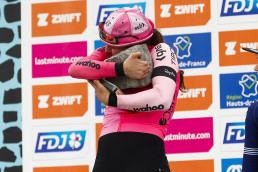
People like her have to fend for themselves. They have to improvise, because otherwise the race goes elsewhere, just like the narrative – because few knew Alison Jackson before that day, and everything would have stayed the same if it weren’t for the fact that cycling is a madman’s game. Cyclists are mad, when it comes down to it. In this madness, an athlete with Jackson’s characteristics attacks 130 kilometres from the finish of the third edition of the women’s Paris-Roubaix, alongside a group of eighteen riders. These are the kinds of moves that almost never work because they make no sense. They’re designed not to work, not to make it to the finish. They’re done because it’s understood that against those who will contest the victory, there’s no chance. So, it’s worth going early to avoid being invisible, because otherwise, many wouldn’t even know you were there.
Athletes in this position have energy to spare. Jackson has energy to spare. She once said in an interview that only the smallest, only children, can keep up with her vitality. She plays with them, challenges them with cries of, “Let’s see who sits down first, let’s see who gets tired first.” She claims she always wins. Anyone who knows anything about childhood knows how hard it is to beat kids at this game.
In the end, that day, first the eighteen and then the seven who went on to contest the victory in the Roubaix Velodrome thought exactly the same way – they were playing that game with the peloton. The bunch was like an adult, too sure of its own convictions, the kind that, deep down, looks down on the little ones, convinced they’re the only ones who’ve figured it all out. They don’t know, or they’ve forgotten, that there’s another level of understanding. That children know things we don’t. The escapees, even those like Alison Jackson, know something more about cycling, even if no one ever believes it. They’re allowed to go because, after all, they won’t make it. But sometimes, they do.
And a Canadian girl, who wanted to be a farmer, by putting her bike ahead of Katia Ragusa’s and Marthe Truyen’s, takes home a cobblestone – one of those embedded in the paths between the fields from Paris to Roubaix. One of those that probably broke a gear or two on that first rusty bike when it was still being ridden by the labourer. Not towards Roubaix, but across the prairies, towards Alison’s father’s farm.
“I wanna rock,” the song says. “I won a rock,” sings Jackson, who, if she read this piece, would say we’re overdoing it, that she had fun, and that you can laugh and joke even about the hardest things. That, truth be told, they’re fun, and for that very reason, you should be happy to face them without thinking you have to save the world. In short, like a true cyclist.

From Abruzzo to Morocco in the name of talent
If, someday, the young people of Zagora in Morocco – the girls, the boys, the little ones – come to know Casa Miriam, it will all be thanks to a journey. And if Casa Miriam truly comes to life, it will be, first and foremost, a sanctuary for talent. It will be a place to discover gifts and nurture them – because talents, just like us, need room to grow once they are born. Latifa Benharara took this incredible journey from 6 October–4 December 2024. She rode her bike through 43 stages, bridging two lands where her roots run deep: Abruzzo, where she lives, and Morocco, where her family is from. The project is called “From Maiella to Sahara”, and we shared it with you back when it was barely more than a fleeting idea. “Morocco is still a poor land,” she told us. “You still find villages built of stone, wood, and straw. In those parts, if families have a daughter and a son, they invest more heavily in the boy, leaving girls with fewer and fewer chances. People mostly use bicycles to get to school or work, and the little ones pass them around and share them, because they often can’t afford to have one each.” In that house – which proudly bears a woman’s name – children will be free to discover what they are actually good at. They will explore what makes them feel alive, what brings them joy, and what might allow them to picture a completely different future. They will dive into drawing, illustration, poetry, writing, acting, and crafts. They will experience sports – all kinds of sports – and perhaps, most importantly, cycling and bicycles. Then, everyone will get to choose their own path. As Latifa beautifully put it, “Because these are the things that allow human beings to change, even if we sometimes forget that.”
Latifa recalls that on the day she left Sulmona, the sun was shining, and her father, just for her, was wearing his Sunday best. He looked handsome – so handsome she had never seen him quite like that – as she rode her bike away from her mother’s house. Shortly after, in the square, she whistled before heading off: yes, just like at the races, but this time the cyclist and the race director were the exact same person. That sense of community is what sparks the applause, bringing different communities together, including the Italian, Egyptian, and Moroccan ones.
But that sun wouldn’t last long, because it was going to be a rainy autumn.
“I remember the climb toward the Muraglione Pass and my father shouting from the camper to get inside, because it was raining too hard and I was going to get sick. No, I kept going just like cyclists do, with a single idea in my head and so much effort. I still picture reaching the summit, just like the night I saw Piazza dei Miracoli in Pisa: there was hardly anyone around, it was freezing, but I was happy and the lights were illuminating the tower.”
Latifa Benharara climbs the Cipressa, making it to the border, “loaded like a mule,” often sticking to the back roads, right as the camper is sent back home because it just isn’t useful anymore. She will become her own support crew, taking care of her bike, giving up a proper place to sleep, to store her groceries and meals, or to find shelter. She will ask for hospitality, and more often than not, she’ll discover that complete strangers are the absolute best part of a journey. Abroad, people will ask her where Sulmona is, they’ll search for it on a map, and they will simply marvel at this woman on a journey.

Borders have always moved her, and even more so on a bicycle, with all those cars passing from one nation to another while she pedals alone, with small flags attached to her bike marking each crossing. She would pass through four nations, starting with France, with the blue sea of the Côte d’Azur, flamingos, fiery sunsets, a warm soup, and a laden table to sit at after changing out of yet another set of rain-soaked clothes.
“The worst face of the rain I experienced was in Spain, when, upon waking, the televisions were talking about Dana, the cyclone that had devastated Valencia. At first, I didn’t understand, I thought it would pass quickly. But no. The sky turned black, the water invaded the sea, churned it up, and erased the roads. We moved around using public transport, and at night, the hotel porters would come to wake us in our rooms to tell us we’d lose power because the water had flooded the basement. The smell of water and mud seeped into everything. It was terrifying.”
Leaving that place, along paths said to be the same ones travelled by Don Quixote, Latifa Benharara felt like a knight, in the ancient sense of the word, someone who believes in values and doesn’t give up. It was almost as if her bike were a horse and she, a rider.

The night is the other side of the journey, where only the moon and stars light the way, villages disappear, and everything feels stronger, more intense. It is the night that guides Latifa toward the “puerto” to catch the ferry: on the other side, Africa. All the checks are done while on the bike, and then she’s off: “It felt like I had arrived, like the journey was already over, because the hardest part was behind me. I would see my uncles again, hear their kind words about me. I would feel at home again, after more than forty days.”
From Morocco, there are memories of Rabat with the mausoleum of the Kings, Casablanca, Marrakech, Zagora, and the desert. Above all, Latifa cannot forget the smiles of so many children, “a way of laughing that is only like that of a child seeing Santa Claus,” yet it was sparked by nothing more than a person on a bike. “You surprised us, you’re unexpected,” some little girls told her, because they couldn’t recall anything like it. Or maybe they could, but only once, many years ago. “Look over there, that shed. If I brought lots of bikes here from Italy and put them inside, would you come ride with me, just for the joy of cycling?” They shouted “yes” in unison, and she didn’t know how to hide her teary eyes.
Pedaling, carrying the bike on her shoulder, or pushing it, she reached the Sahara, where there are only tents, camps, and sand. And a breeze that “is everything and nothing.” She admired the desert night and found it as beautiful and clear as the skies of Everest. By the end of the fifty-eight days, the bicycle was no longer just a means of transport but something with a life of its own, something that, through its pedals, allows you to keep going even when your muscles are too tired.
She knows she will return to Morocco soon, because she dreams of it, because a part of her, deep down, stayed there. She envisions organised trips where tourists can explore and discover realities that are usually left untold. In her nostrils, she still carries the scent of vegetation from certain Tuscan fields after an afternoon rain and the fragrance of lavender she found in France. She struggled to readjust to life at home, as her instincts kept pulling her toward the desire to set off again, just as she had done every one of those days, after a brief morning visit to the city or village where she had spent the night.
“I’ve learned that we need to travel light, not just on a bicycle, but in our daily lives. To laugh at our mistakes, even if we’re at the summit of a Pyrenean climb and, after all that effort, find the road closed: anger is useless, disappointment is a burden we cannot afford. Above all, I’ve learned that we must take care of our bodies, just as we take care of the bicycles we travel on: it’s our only chance, the only home we inhabit, no matter where we are in the world.”
Just not ride