


Roger De Vlaeminck, one of only three cyclists in history to have won all the Monument Classics, said after his second victory at Paris-Roubaix: “As a cyclocross world champion, I would have refused to race on a course like today’s. I’m twenty-seven years old; I’m too young to die.” Yet, he would return to the Hell of the North for another eight springs, claiming two more victories and three second places.
To the very exclusive group of those who have managed to win all five Monument Classics, which also includes Eddy Merckx and Rik Van Looy, Tadej Pogačar could have been added on Sunday. With the victory, the Slovenian would have also become the first in history to win all five classics consecutively.
For the world champion, the situation became complicated, though not yet irreparable, over 120 kilometres from the finish. A puncture in the usually uneventful Quérénaing to Maing sector forced him to chase a group already at full speed, after a first half of the race ridden at nearly fifty kilometres per hour on average. In the main group, it was primarily Alpecin – and van der Poel himself – making life incredibly tough for the world champion. The chase, involving a long-distance battle between UAE and the other teams, was resolved after more than twenty kilometres, just in time to tackle the Arenberg Forest at the front. As in every edition, it is in the Trouée d’Arenberg that the race truly ignites. Legend has it that you cannot win Paris–Roubaix in this sector, but you can certainly lose it. A puncture here means losing at least a minute and a half, as the group is stretched out, and the many riders scattered at the back prevent team cars from closely following their leaders. This time, fate’s victim is Mathieu van der Poel, who suffers two punctures, while his teammates assist him as best they can in a theatre of the absurd.
The race of any other athlete in the world would be compromised. There are still 90 kilometres to the finish, but at Paris–Roubaix, being two and a half minutes behind means having no chance of coming back. This would be true for everyone, but van der Poel made us believe for a long time that this rule did not apply to him. That moving chase, climbing through groups and small clusters to rejoin the other pre-race favourites, could only have been achieved by the Alpecin leader. He raced not only with great legs but also with great intelligence: pulling for long stretches, taking the opportunity to catch his breath when he found a brief companion in adventure, and then leaving them behind on the cobbled sections. With this method, he eventually rejoined the group of top riders, which included prominent names from the northern classics: Pedersen, Bissegger, Laporte, Stuyven, and Mick Van Dijke.
Almost everyone, because even further ahead was the leading duo of Pogačar and van Aert. The two favourites had also faced mechanical issues during van der Poel’s long chase, but they had managed to get back to the front. For Tadej, it had been relatively straightforward, while van Aert had needed more time (and the help of the Red Bull duo Pithie-Meeus) to regain the lead. At that moment, the presence of Christophe Laporte proved to be crucial.
For van Aert’s critics, Laporte is immediately associated with a moment of perceived lack of competitive ruthlessness from the Visma captain. In 2023, at Gent–Wevelgem, the two teammates broke away together, building a massive lead over the peloton. For van Aert, it wouldn’t have been an issue to drop the Frenchman or even beat him in a sprint, but he chose to let him win. He should never have done so, according to many. For them, it’s a clear symbol of how van Aert lacks the killer instinct that defines every true cycling champion. Eddy Merckx would never have handed a victory to a teammate, they argue.
If Laporte hadn’t been in the leading group, the Belgian’s return after the puncture would have been even more challenging. His presence intimidated the others, as the former European champion had secured a series of strong results in these spring classics and remained an opponent not to be underestimated, particularly due to his sprinting ability. Moreover, he often slotted into the line to disrupt the rotations and break the rhythm. All of this was, of course, entirely within the rules but also crucial in helping his captain rejoin during the most difficult moment of his Paris–Roubaix.
Van Aert won not only (and not so much) because he had the strongest legs, but also because he was tactically the sharpest over the last hundred kilometres. In the decisive moments, it was he who animated the race. It was him at the front, in the Forest of Arenberg, when van der Poel punctured for the first time, effectively compromising his bid for a fourth consecutive victory. And it was him again who shaped the two-man scenario at the head of the race, with the attack launched before entering the Auchy-lez-Orchies to Bersée sector, which only Tadej managed to withstand. A perfect attack because it came not on the cobblestones, but in the couple of asphalt bends preceding them, taking advantage of Laporte’s presence at the front of the group.
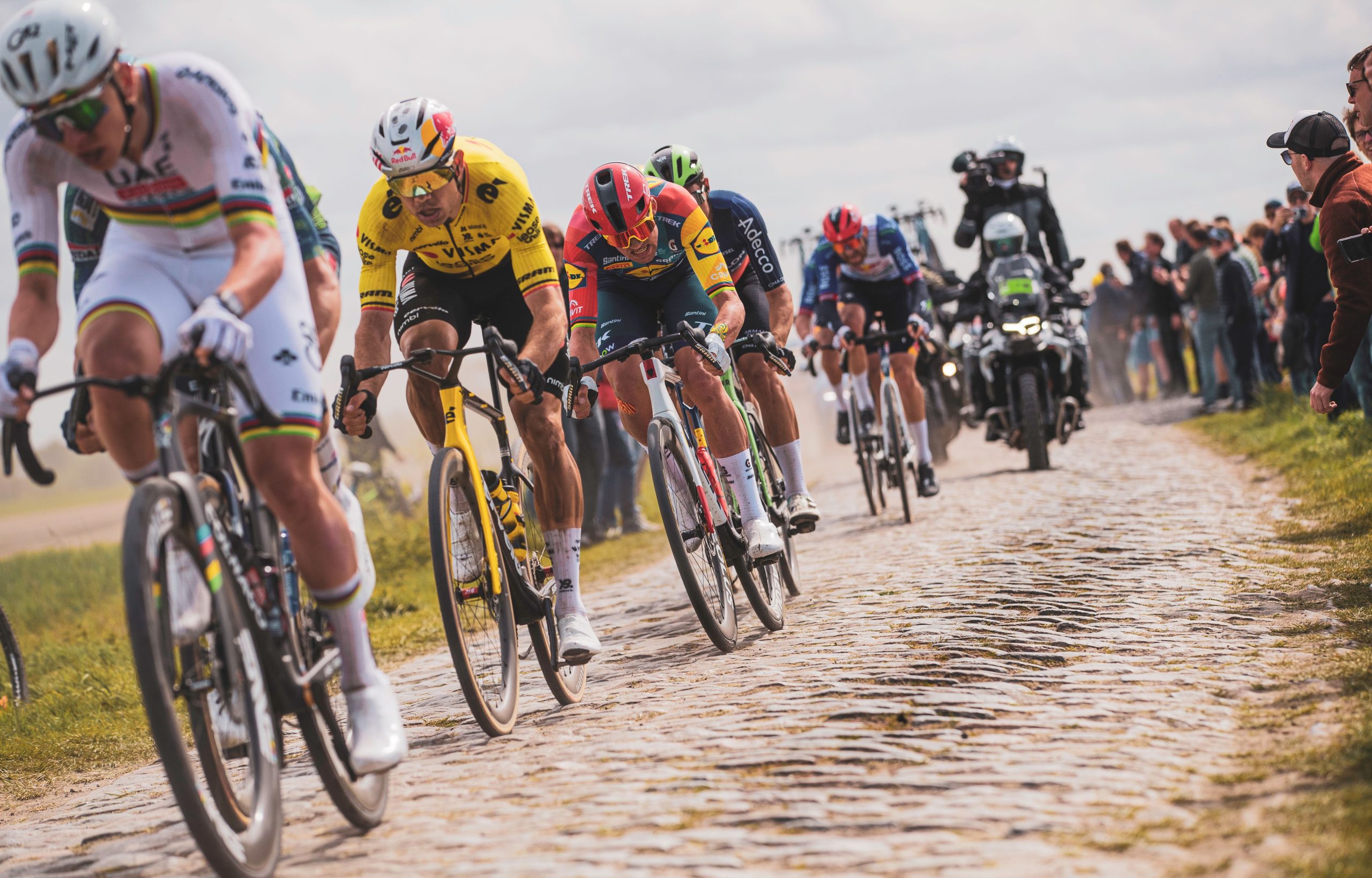
And he didn’t make the mistake of collaborating too much, of giving his all only to then be dropped by Pogačar. This was particularly evident before the Carrefour de l’Arbre. It was in this final five-star sector, positioned less than twenty kilometres from the finish, that the world champion had his best chance to secure a fifth consecutive Monument. Van Aert, however, used the preceding kilometres to catch his breath and stay on the wheel as much as possible. After all, it was the world champion who was the favourite, the man to beat after van der Poel had fallen behind. Most of the workload naturally fell on him. Van Aert resumed working only after passing that cobbled sector, knowing that the race would inevitably come down to a two-man sprint. This was the most favourable scenario for the Belgian from Visma, who, after all, had never been able to shake Pogačar off his wheel.
On paper, Wout was supposed to be the favourite in a two-man sprint. However, things were far from certain, and for several reasons. Firstly, there are no clear hierarchies after 258 kilometres (54 of which on cobblestones) raced at an average speed of 48.9 km/h. Secondly, just three weeks ago, Pogačar had won his first Milan–San Remo by beating Tom Pidcock in a two-man sprint. Four years ago, van Aert was capable of defeating Philipsen and Cavendish on the Champs-Élysées. But only last year, he lost Dwars door Vlaanderen to Powless in what was considered the most embarrassing defeat in Visma’s history.
Wout van Aert had already lost a Monument Classic in a two-man sprint. It was the 2020 Tour of Flanders, held in October during the season disrupted by Covid. This marked the first road chapter of the van Aert–van der Poel rivalry, a duel the two cyclists had been living since their junior days in cyclocross. The Dutchman, wearing the reigning champion’s jersey, led the sprint from the front. On paper, the better position belonged to the Visma rider. The sprint began, the two rode side by side, but van Aert couldn’t manage to overtake, and the photofinish awarded victory to his lifelong rival. We know how their careers have unfolded since that day. What we don’t know is how things might have turned out if the sprint had gone the other way, even by just a few centimetres. We don’t know, but after what we saw yesterday at Roubaix, it matters less.
Even in the velodrome, van Aert chooses to start from the second position. Pogačar is therefore in front, the same position from which he had already beaten Pidcock in the finale on Via Roma. This time, however, it is not the rainbow jersey that raises its arms in victory. The Belgian launches his sprint before the final curve. He pulls alongside, and it’s immediately clear that there’s no contest between the two. Too fast, too powerful, perhaps too hungry. It almost seems obvious that it had to end this way, that it was only right to see van Aert triumph on this 12th of April, 2026.
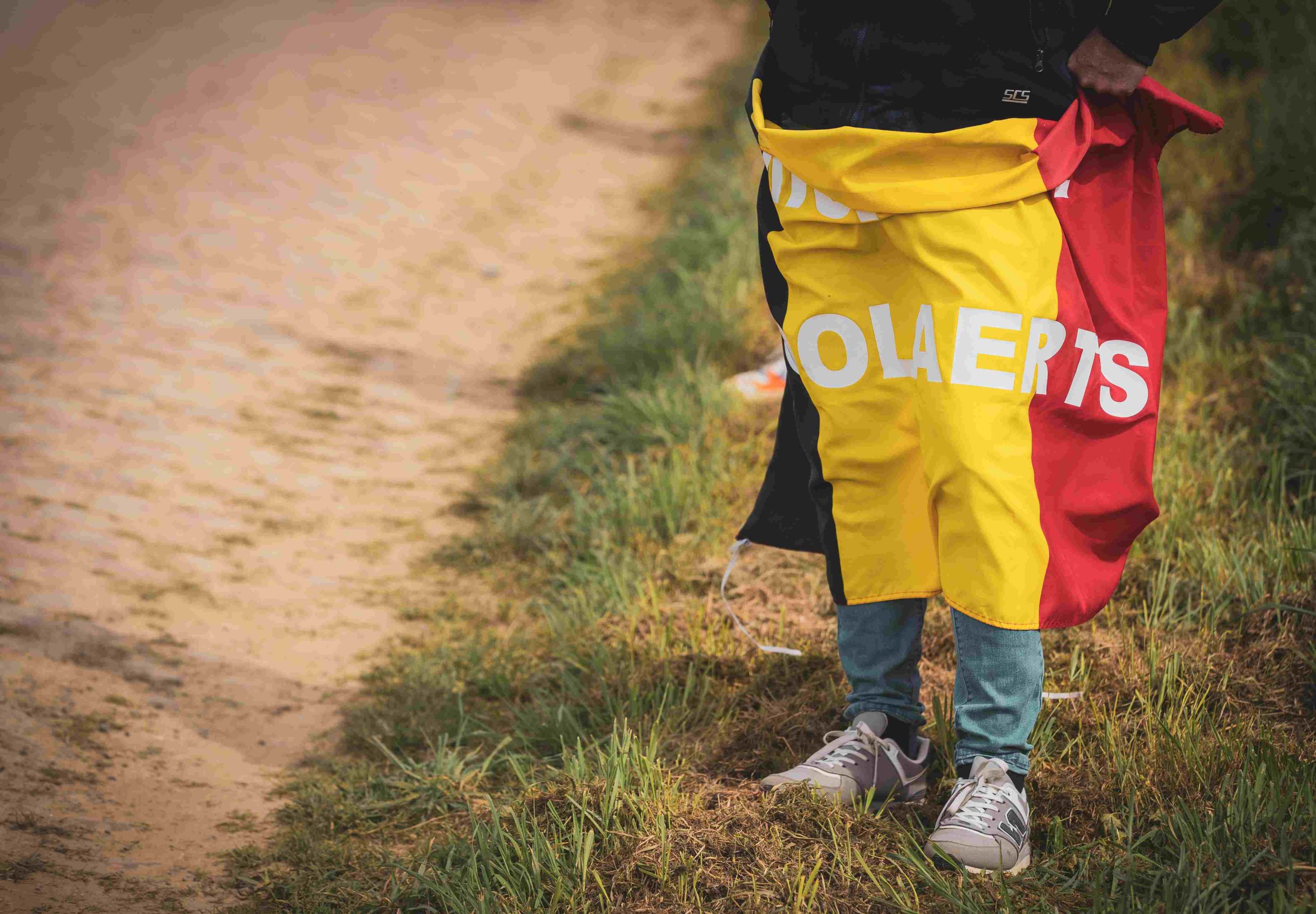
Everything that followed the race was perhaps even more beautiful. Starting with Wout’s dedication, who, as soon as he crossed the finish line, raised a finger to the sky. The tribute was for Michael Goolaerts. Born in the same year and both raised in Antwerp province, in northern Flanders, the two had raced as rivals in all youth categories. They later became teammates and friends at Vérandas Willems-Crelan, during their debut as professionals. Eight years ago, on the 8th of April 2018, the two Flemish riders made their debut at the Hell of the North. But while van Aert finished thirteenth, Goolaerts stopped due to a medical emergency and passed away that same evening. A heart attack struck the 23-year-old professional athlete, who just a week earlier had been in the breakaway at the Tour of Flanders. A tragedy that van Aert has never forgotten, and it became his goal to honour his former teammate in the race that had taken his life.
Then there were the hugs with his family, the kisses for his wife Sarah, and high-fives for his sons Georges and Jerome. Even van Aert’s family had been the target of criticism from the Flemish media, often cruel towards their greatest talent of the last decade. Too often, they questioned how he could go to his children with a smile at the finish line, even after losing a sprint where he was the favourite.
And there was the joy of an entire nation – the Belgian people – who had been waiting for years for one of their riders to win again during the holy week: the two Sundays when Belgium comes to a standstill for the Tour of Flanders and Paris–Roubaix. The last victor had been Gilbert, with his solo arrival at the velodrome in 2019. A seven-year drought, unprecedented in its length, that only van Aert – the athlete everyone had been waiting for – could break. And so, the voices of the commentators on Walloon and Flemish television went wild – a testament to how cycling truly serves as the glue that unites the two communities sharing Belgium. Meanwhile, in Mechelen, the KV fans already cared little about their recent home defeat and were celebrating from the stands.
The most beautiful words, in the end, came from Wout himself. A rider who has won ten stages at the Tour, three at the Vuelta, and one at the Giro, as well as Milan–San Remo, the Amstel Gold Race, Strade Bianche, Omloop, and countless other races, had until now been remembered primarily as a great loser. Someone who had collected dozens of podium finishes in Monuments but had been completely overshadowed by his great career rival. Someone who had to settle for finishing third or fourth—always third or fourth in recent years. Someone who, in his finest moments and when he seemed to be in peak form, had been forced to stop due to terrible injuries. The thigh wound at the Tour in 2019, the crash at Dwars door Vlaanderen in 2024, and the withdrawal from the Vuelta that same year. How do you keep believing after all those defeats?“I stopped believing many times, but the next day I got up and started fighting again”.